3-Tab vs Architectural Shingles: Cost, Look & Lifespan
3-tab shingles cost less upfront but architectural shingles last 10+ years longer and look better. Side-by-side comparison to help you decide.
February 8, 20269 min read
If you are replacing an asphalt shingle roof, the first real decision you will face is whether to go with 3-tab shingles or architectural (dimensional) shingles. Both are asphalt-based, both are widely available, and both are installed by every roofing contractor in Middle Tennessee. But they are meaningfully different products, and the choice affects your roof's appearance, performance, lifespan, and long-term cost.
This guide lays out the comparison directly — no fluff. By the end, you will know exactly what you are trading when you choose one over the other.
Everything that separates 3-tab from architectural shingles flows from one fundamental difference in how they are manufactured.
3-tab shingles are a single-layer product. One thickness of fiberglass-reinforced asphalt, coated in granules, with three evenly spaced cutouts along the bottom edge that create the appearance of three separate shingles when installed on a roof. Simple construction, consistent thickness throughout, flat profile.
Architectural shingles are a laminated (multi-layer) product. Multiple layers of asphalt-saturated material are bonded together — the base layer running the full length of the shingle, with a shorter upper layer laminated on top. This creates a thicker, heavier shingle with a non-uniform profile that produces visible shadow lines on the roof. The extra mass also contributes directly to wind and impact resistance.
This construction difference drives every other performance gap between the two products.
This is often the deciding factor for homeowners who have already done the math on cost, and the visual difference is not subtle.
3-tab shingles create a flat, uniform surface. The repetitive tab pattern is obvious from street distance, and there is no shadow or texture variation. The look is clean and functional, but it reads as basic. It is the visual equivalent of standard carpet versus hardwood floors — it covers the surface, but it does not elevate the home's appearance. On a ranch home or outbuilding where the roof is not a prominent visual feature, this may not matter. On a two-story home where the roof is highly visible, the difference is significant.
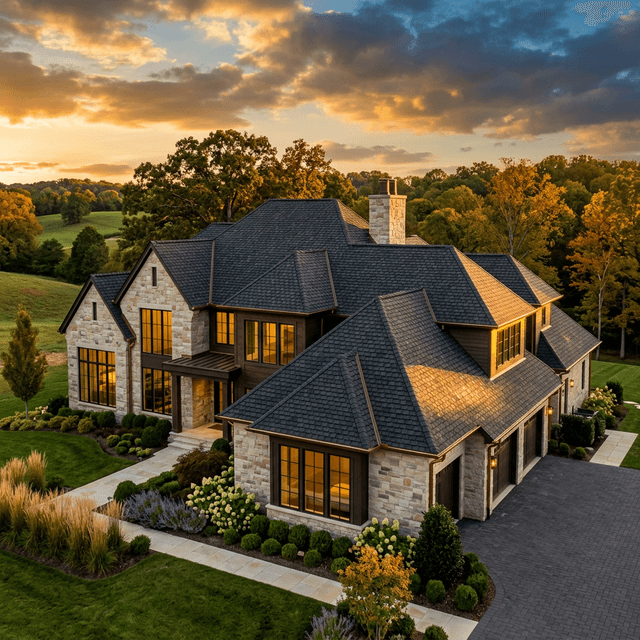
Architectural shingles create a textured, three-dimensional surface with visible shadow lines. The irregular tab shapes and varying thicknesses give the roof genuine visual depth that reads differently — richer, more premium — from the street. Well-installed architectural shingles are often compared to wood shake in their visual effect, and the best products genuinely deliver on that comparison from street distance.
If you have ever admired a neighbor's roof and thought it looked particularly good, there is a high probability you were looking at architectural shingles.
The Shadow Line Test
The easiest way to visually distinguish 3-tab from architectural shingles from the street is to look for shadow lines. If you see consistent dark lines running horizontally across the roof surface in a pattern that suggests real depth and thickness variation, that is an architectural shingle. If the roof surface looks completely flat and even, with simple rectangular cutouts visible, that is 3-tab.
The weight difference between these two shingle types is one of the most consequential performance variables — and it is one that is easy to overlook.
3-tab shingles weigh approximately 175 to 225 pounds per roofing square (100 sq ft of roof surface). This is relatively light, which means they are easier to lift and faster to install, but also means there is less material mass resisting wind uplift forces.
Architectural shingles weigh 240 to 340 pounds per roofing square — roughly 30 to 50% more than 3-tab shingles. This added mass serves two functions: it increases the mechanical resistance to wind uplift (heavier shingles require more force to lift), and it means more asphalt and granule material protecting the underlying structure from heat, UV, and water.
The weight difference is why architectural shingles are physically harder to blow off in a storm. The shingle has to be lifted before the wind can work on it, and a heavier shingle requires more initial force to lift.
If you live in Middle Tennessee and you want to understand the practical difference between these shingle types, focus on wind resistance. This is where the gap is most stark and most consequential.
3-tab shingles: Standard products carry a 60 mph wind rating. Enhanced versions may reach 90 mph. These ratings reflect the wind speed at which the shingle manufacturer will honor warranty claims for blow-offs.
Architectural shingles: Standard products are rated for 110 mph. Premium versions — including GAF Timberline HDZ, Owens Corning Duration, and CertainTeed Landmark Pro — achieve 130 mph wind ratings with proper installation.
To put this in context: Middle Tennessee experiences severe thunderstorms with gusts exceeding 60 mph multiple times per year during storm season. Tornado events in the region routinely produce EF-0 and EF-1 category winds in the 65 to 110 mph range on the periphery of the damage path. A 3-tab shingle roof is operating at or beyond its rated wind tolerance in these events. An architectural shingle roof has significant margin.
Insurance adjusters in Tennessee see this play out constantly. After severe weather events, post-storm inspections of neighborhoods with older 3-tab roofs reveal widespread shingle losses and blow-offs. Architectural shingle roofs in the same neighborhoods typically show isolated damage rather than systemic failure.
Wind Rating Is Not a Guarantee
A 60 mph wind rating on a 3-tab shingle does not mean the shingle will survive any storm up to 60 mph and fail at 61 mph. Wind resistance ratings are tested under controlled laboratory conditions with optimal fastening. Real-world performance depends on installation quality — specifically the fastening pattern and nail placement. Even architectural shingles can fail in storms if improperly installed. Use a manufacturer-certified contractor who follows the required fastening schedule for your chosen shingle.
Lifespan is where the cost comparison between 3-tab and architectural shingles becomes genuinely interesting, because the cheaper product may not be cheaper over time.
3-tab shingles carry manufacturer warranties of 20 to 25 years, but real-world lifespan in Tennessee averages 15 to 20 years. Heat cycles, UV exposure, storm impact, and the product's single-layer construction all contribute to earlier failure relative to rated warranty terms.
Architectural shingles carry manufacturer warranties of 30 years to lifetime (depending on product and contractor certification). Real-world lifespan in Tennessee averages 25 to 30 years for standard architectural products, with premium lines reaching 35 years or longer.
This means a homeowner who installs 3-tab shingles today is likely to need another replacement in 15 to 20 years. A homeowner who installs architectural shingles may go 25 to 30 years before that decision comes up again. The compounding effect over a 40-year home ownership period is significant.
The bundle-level price difference between 3-tab and architectural shingles is modest:
3-tab shingles: $80 to $100 per bundle (three bundles cover one roofing square)
Architectural shingles: $100 to $130 per bundle
The difference is roughly $20 to $30 per bundle, or $60 to $90 per roofing square. On a full roof replacement for a typical Tennessee home (25 roofing squares), the material premium for architectural shingles over 3-tab runs approximately $1,500 to $2,250.
Here is where the calculus shifts. If you install 3-tab shingles at $14,000 and replace them at year 18 for $16,000 (accounting for inflation and market increases), your 36-year roofing spend is $30,000.
If you install architectural shingles at $17,000 and they last 28 years before needing replacement at $19,000, your 28-year roofing spend is $36,000 — but you have also gone 28 years without a second replacement, and you have had a better-performing, better-looking roof throughout.
The math is not always this clean in practice, but the directional conclusion holds: the lifetime cost difference between 3-tab and architectural shingles is smaller than the upfront cost difference suggests, and may favor architectural shingles once you account for the replacement cycle.
Workmanship coverage: typically provided by contractor separately
Architectural shingle warranties:
30 years to lifetime limited, with non-prorated coverage for extended terms through certified contractor programs
Wind warranty: 110 to 130 mph, with proper installation
Algae coverage: available as a warranty feature on many lines (StainGuard, Scotchgard protection)
System warranties: available when using full manufacturer component ecosystem (underlayment, starter, ridge cap)
The practical implication: if a manufacturing defect causes premature shingle failure at year 12, an architectural shingle owner with a certified contractor installation may have full replacement coverage. A 3-tab shingle owner at year 12 may have prorated coverage worth a fraction of the replacement cost.
This is a factor that some homeowners underweight and later regret.
Studies on roofing and home resale consistently show that architectural shingles increase resale value and buyer appeal compared to 3-tab shingles. A new architectural shingle roof is a positive line item in a real estate transaction — it is visible, clearly premium, and communicates recent investment. A new 3-tab shingle roof fulfills the functional requirement but does not move the needle on perceived value.
If you are planning to sell within the next 5 to 10 years, installing 3-tab shingles may limit your return relative to architectural shingles. Real estate agents in the Nashville market routinely cite roofing material as a factor in buyer perception.
Market Share Tells the Story
Architectural shingles now account for more than 80% of all residential asphalt shingle installations in the United States. The market has voted decisively. The modest cost premium over 3-tab has been broadly judged worthwhile by homeowners, contractors, and the manufacturers themselves — which is why major brands like GAF and Owens Corning continue to invest in their architectural lines while their 3-tab offerings have remained largely unchanged for decades.
There are genuine use cases where 3-tab shingles remain a reasonable choice. Honest guidance requires acknowledging these rather than simply dismissing them.
Outbuildings and secondary structures: A detached garage, workshop, barn, or accessory dwelling where appearance is not a priority and budget is tight. 3-tab shingles provide functional weather protection at minimum cost.
Very short-term ownership: If you are selling a rental property within 12 to 18 months, need functional roofing for that period, and are pricing for quick disposition, 3-tab shingles may be defensible.
Extreme budget constraints: In situations where the project has to happen and the budget simply cannot stretch to architectural, 3-tab is better than a failing roof. That said, we encourage homeowners in this position to explore financing — the cost difference between the two products is manageable on almost any financing plan.
Matching existing 3-tab sections: If you are replacing a partial roof section on a home with existing 3-tab shingles and matching appearance is important, 3-tab replacement may be the right call. However, if the existing 3-tab sections are more than 10 years old, full replacement with architectural shingles is usually the better long-term move.
For most primary residences — especially in Tennessee's storm environment — the case for 3-tab shingles over architectural shingles is very difficult to make on merit. The performance gap is too large and the price gap too small.
If you are replacing the roof on a primary residence in Middle Tennessee and the budget allows even a modest stretch, architectural shingles are the clear choice. Better wind resistance, 10 or more additional years of life, superior aesthetics, stronger warranties, and a lifetime cost that is competitive with or better than 3-tab shingles when the replacement cycle is factored in.
3-tab shingles remain available and remain a valid option for specific applications. But the residential roofing market has largely moved on from them, and for good reason.
For help choosing the right architectural shingle product and understanding the installed cost for your specific home, visit our shingle roofing services page or try our free cost estimator below.
Get Your Exact Roof Cost
Answer 5 quick questions and get an instant price range — free, fast, no obligation.
The Opus Roofing team brings decades of combined experience in residential roofing across Middle Tennessee. We're licensed, insured, and committed to helping homeowners make informed decisions about their roofs.
Compare the three types of asphalt shingles: 3-tab ($80-100/bundle), architectural ($100-130/bundle), and designer ($130-250/bundle). Features, costs, and lifespans.
Laminate (architectural) shingles are the most popular roofing choice in America. Learn what makes them different, their benefits, costs, and top brands.